

Artificial intelligence and international QR payments: SQB discussed the future of banking technologies at the FINOBOD forum
- 14 November 2026
- FINOBOD forum, Tashkent
- SQB representative Sergey Kozlov, Octobank representative Roman Tretyakov, Click representative Naima Mirzaeva, HUMO representative Islam Diyarov, PAY10 representative Ekaterina Zemskova
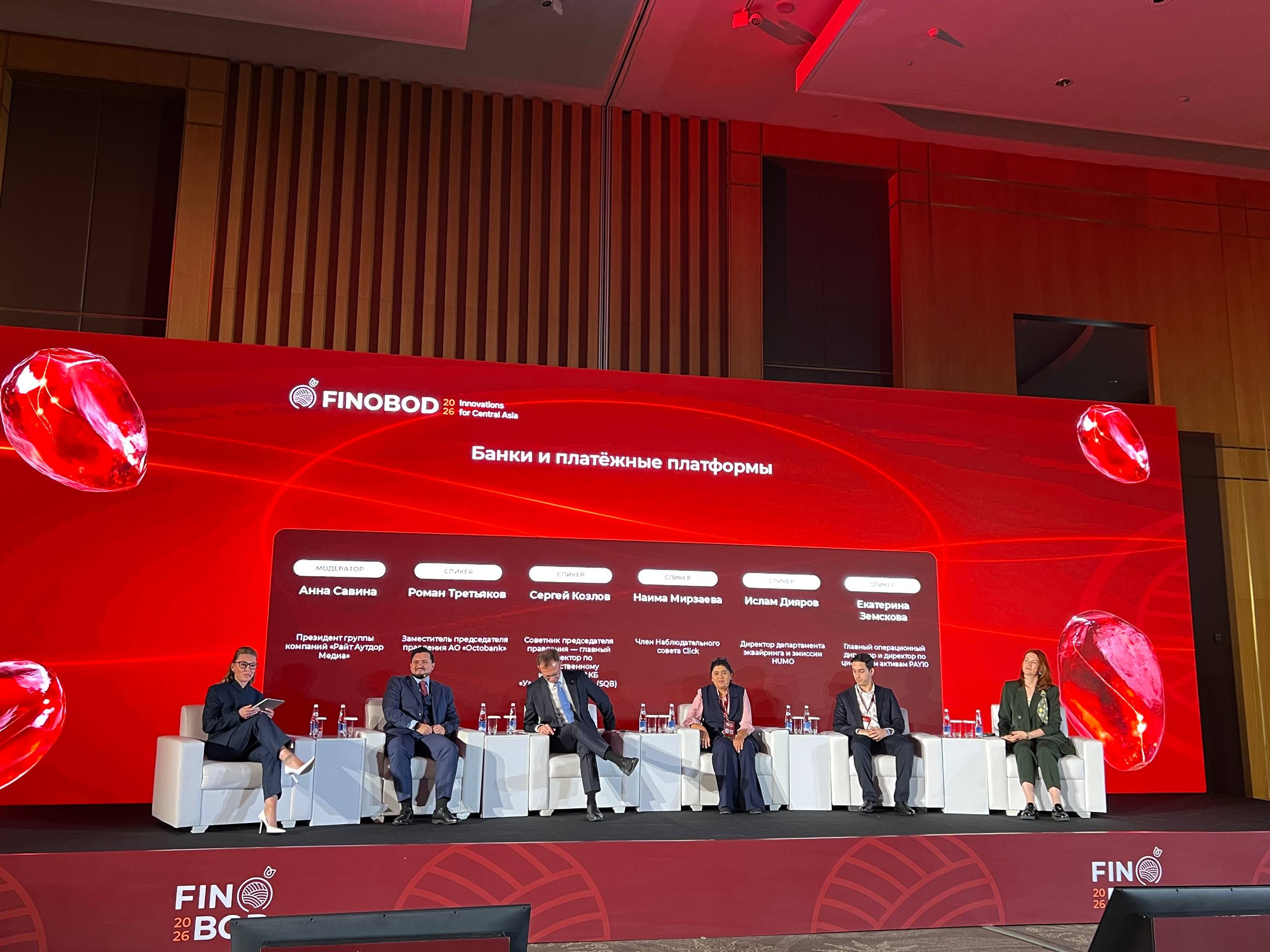
The banking market is moving toward a model in which artificial intelligence performs financial operations on behalf of the client, and familiar payment instruments can be used beyond one’s own country. These changes became one of the main topics of the “Banks and Payment Platforms” session at the FINOBOD forum in Tashkent.
Roman Tretyakov of Octobank cited the example of AI agents capable of independently selecting airline tickets, booking a hotel, and completing the payment. According to him, the bank is developing a Banking as a Service model, providing financial infrastructure on which partners can build their own services.
Sergey Kozlov of SQB spoke about implementing AI in lending. In his view, a credit decision must be explainable, and instead of an automatic refusal, the client should be offered alternative terms, for example installment plans or flexible repayment schedules. The bank also uses shared technological components for speech recognition, document processing, and other tasks.
Naima Mirzaeva of Click spoke about the application of AI for personalizing financial services and supporting users. At the same time, the development of technologies is accompanied by increasingly complex fraud schemes. Payment companies have to simultaneously improve the automatic detection of suspicious operations and warn clients about risks.
Islam Diyarov of HUMO raised the issue of the cost of QR payments and the expenses of maintaining them. He also noted that the international integration of payment systems requires harmonizing procedures for customer identification, anti money laundering, and the exchange of transactional data.
Ekaterina Zemskova of PAY10 spoke about the possibility of connecting the national QR systems of different countries via API. This will allow travelers to pay abroad using their usual payment instruments. Another promising direction is stablecoins, which can speed up and reduce the cost of cross border transfers if local regulation permits.
Thus, the key changes affect not only payment methods but also the very architecture of financial services, from AI agents to the international compatibility of payment systems.